

Project #1: Creative Work (and Blocked Dreams)
Studying the creative impulse, and all of the things that mess it up

Author’s Note: Hello, everyone. With this first article of the new year I’m announcing a new project. Several months ago I posted a note regarding my intent to become a public academic—this will be my first formal project along those lines, and should last for the next year. As it stands, the plan is to study… work! Read further for more information.
J
Introduction
We don’t have access to the personal correspondence of Marcelino Sanz de Sautuola. As such, most of what we know about him has to be inferred from public documents and the testimony of others. For those who are willing to spend the time needed to find and read those sources, however, three facts stand out, and quickly:
First, Marcelino Sanz de Sautuola was a truthful man, and not just in the watered down, American, “I cannot tell a lie” sense of the word. He was inquisitive, thorough, and brave, and those traits in turn made him well suited to finding the truth, to documenting the truth, and to defending the truth.
Second, Mr. Sautuola loved his daughter Maria very much, and took her on adventures.
Third, because of #1 and #2, the world will forever remember Maria as the young girl who shattered our understanding of humankind.
There are only a few events in history, I think, which represent a true break point in the story we tell ourselves about humanity. I’m attracted to such events because of their liminality—they represent a sort of “between space” in our understanding of mankind, and when you look at the ideas that do battle in that space you can learn a lot about what makes us who we are.
The story of the Sautuolas contains one of those insights—and it is the core of the work that I will be doing for the next year. I wanted to share it with you. So let’s talk about Santillana del Mar.
I. The Man in the Cave
The hills surrounding Santillana del Mar are ancient.
Technically, of course, every landscape is ancient. But some landscapes hide their age. Alaska, where I live, is youthful; the mountains here are old but the surfaces that humans make contact with are young. Anchorage is quilled with trees a few centuries old, at most. Its bays are full of mud-flats made of silt that shifts and renews with the tides. Its lakes are fed by January’s snow. The glaciers, at least, are ancient, but also, they’re melting.
Santillana del Mar, in contrast, lies on the northern coast of Spain, between the Sierra del Escudo de Cabuérniga1 and the Cantabrian Sea. Millions of years ago the sea hosted endless generations of sea life that bloomed and then died, depositing their shells on the seabed below. Aeons of geological activity compressed those shells into a layer of limestone, which in turn was forced inland by tectonic activity, and carved into a porous mess of karst by millennia of running water.
The limestone caverns that pock the landscape, then, are truly ancient. To enter them is to enter spaces so old that the numbers we assign to them cannot carry the meaning of the time that has elapsed. Step into one and you are a lonely little grain in the hourglass of God, and if you have any sense at all, you feel it.
Periodically some external force such as an earthquake, or erosion, causes a part of a cave to collapse. When that happens the space inside is sealed off like a time capsule, and can remain hidden indefinitely. There are spaces in the Cantabrian foothills that have kept themselves from us for the entirety of written history. We know this for a fact because every few years an inquisitive soul opens one of them up, and we find what was hidden there.
In 1879, Marcelino Sanz de Sautuola and his daughter Maria entered the cave on their property in search of hidden things. They had barely an inkling of what they would find. Marcelino Sautuola was dreaming of trinkets; a year prior he had attended the 1878 World Fair in Paris, France, where prehistoric archaeologists had started to make their academic discipline known. Of particular interest to Sautuola were the exhibits—small artifacts of engraved bone, antler, and stone. Scholars argued that they might be decorative, which was an odd assertion, contradicting the conventional wisdom that prehistoric man was little more than a beast, capable of creating tools, but without the capacity for art or whimsy.
A decade earlier, in 1868, Sautuola had been approached by an acquaintance of his—a local telero named Modesto Cubillas, who sometimes requested to use his land for hunting. While Cubillas had been exploring the property his dog had disappeared briefly into a fissure in the landscape. Cubillas, who knew of Sautuola’s interest in prehistory and the natural sciences, thought it would be of interest to him.
And it was. Sautuola had entered the cave before and found evidence of prehistoric occupation—tools of flaked stone. Scattered animal bones. Now, however, mind fresh with new theories, he purposed to visit it again. His daughter Maria came with him.
The next part of the account is perhaps the most charming. The ceiling of the main gallery of the Altamira cave was low. Sautuola was a fully grown adult, and it was likely that he had to stoop or crouch in order to make his way in the dark. This was little problem to him, because the only parts of the cave that were of interest to him were the small artifacts of prehistoric occupation strewn about the floor.
Maria, meanwhile, was small, and inquisitive, and had plenty of room to look wherever the lamplight fell—including the ceiling. And when she did look up? She saw this.
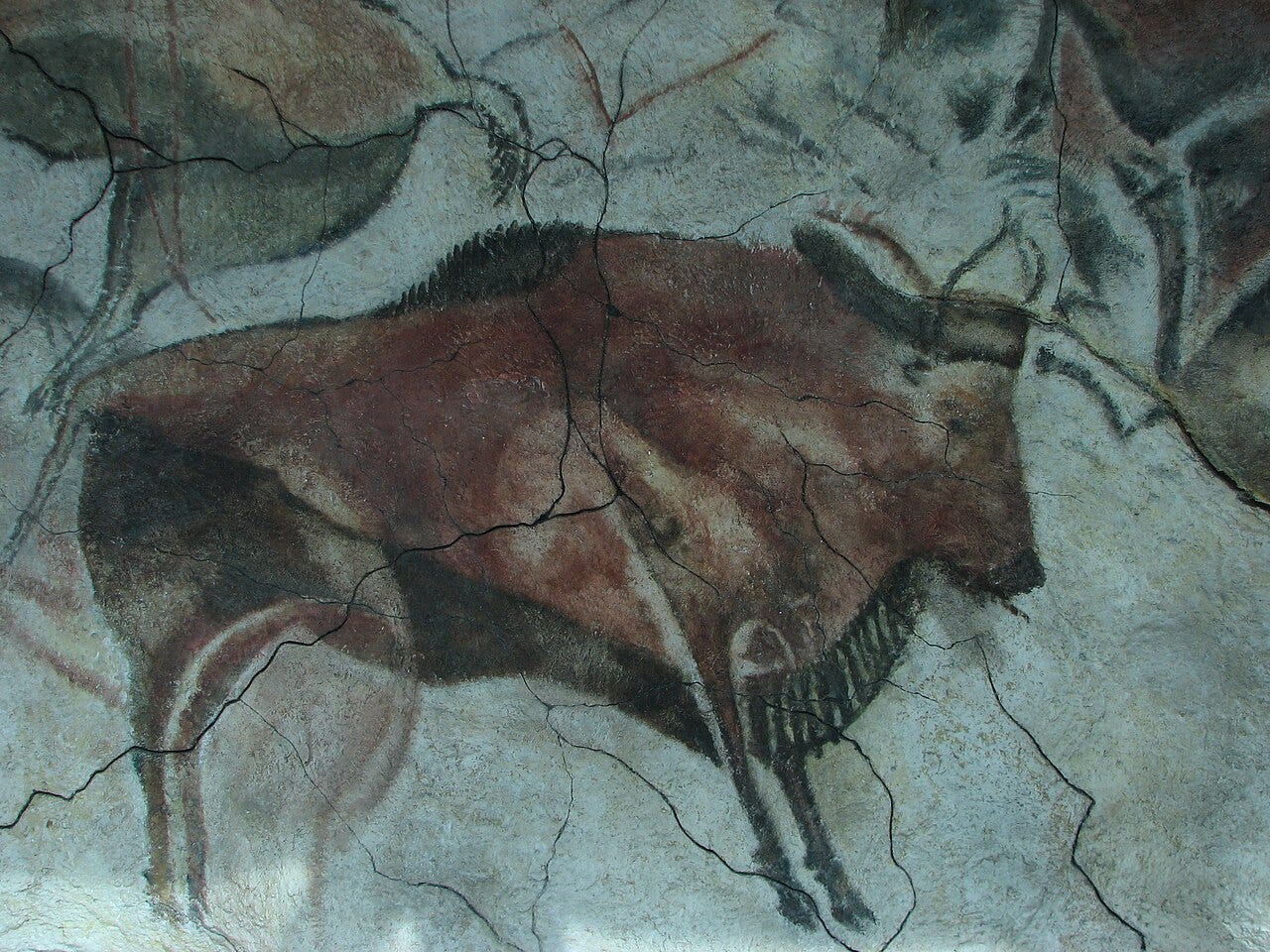

Her next, breathless words, “Mira, papa! Bueyes pintados!”2 mark a tide-change in our understanding of prehistoric man. Up until that point, it was thought that early humans were savages whose lack of civilization made art impossible. In this view, art was a gift granted by human culture—and early man, being in a “state of nature,” should barely have barely been able to think about art, let alone make it.
The bueyes pintados suggested that something was wrong with this account—perhaps just the timeline? Just how much civilization did mankind need in order to produce art? Because the ceiling at Altamira suggested that all humans really needed was a steady stream of prehistoric beef and some free-time.
Her father Marcelino was humble enough to recognize what it was that he was looking at, and reached out to scholars in Madrid. The next year, in 1880, the world received the news that prehistoric man was an artist.
II. The Signature of Man
That last line—prehistoric man was an artist—is the departure point for my newest project. I’m not quite sure that people appreciate what a radical idea it is. But to give you an idea, it will help to know that, shortly after the publication of his 1880 paper, Marcelino Sanz de Sautuola was widely accused of fraud (or at least self-deception) by the leading academics of the time.
Why? Well, there were some legitimate reasons for skepticism, not least of which was the incredible state of preservation of the artwork. But the problem was also philosophical: Sautuola’s opponents simply did not have the interpretive framework needed to accept that cave-men might be capable of art.
The emerging sciences of the time prided themselves on doing away with sentimental notions about human nature. If humankind emerged from the rough stuff of evolutionary processes, then prehistoric man, being a few rungs down on the ladder of evolution, should be more animal than man—or that was the thought. The public sphere was already bustling with tales of prehistoric savagery.
The greatest source of skepticism, then, was that some of those cave drawings were really, really good. They showed an artistic attention to form and line that, by the modern account, prehistoric man simply shouldn’t have been capable of.
This debate was, I think, captured best by G.K Chesterton. He was one of the most insightful (and scathing) of the late Victorian literati. In the opening chapter of his book The Everlasting Man he highlighted an absurdity in the modern position: every man of science at the time believed that early man was a savage, in spite of a complete lack of evidence supporting that belief. And the same men of science couldn’t bring themselves to believe that he was an artist—in spite of the fact that there was overwhelming evidence that early humans made things, and were often surprisingly good at it.3
One way to view the troubles of Sautuola, then, is to say that he got caught in the crossfire of an ongoing war. At the core of it is a single question - how deep does the art run?
On the one hand there is the skeptical impulse, the nature-red-in-tooth-and-claw crowd, who believe that the fundamental truth of man is that he’s a violent ape, and that if you trace the thread back far enough, the art will eventually run out and you will be left with humans that are nothing but (as Stephen King so eloquently put it) “the most murderous motherfuckers in the jungle”.
And on the other hand you have those who believe, to quote Chesterton, that “art is the signature of man.” According to this crowd, creation is the defining feature of humankind. Violence may be part of us due to our animal nature4 but there is no point in our past where you will find humans who were all violence, without their corresponding urge to create things, and perhaps even beautiful things.
Today we have mostly settled on the latter. Art and tools are one of the primary markers of humanity on the fossil record. While there are other branches of hominid, such as neanderthals, that also used tools, the presence of tools is one of the surest pieces of evidence that we are dealing with a creature that is “like us”.

III. What I’ll Be Doing For the Next Year
I’m pretty sure that, if you’ve read this far, there are a couple things that are true about you. Normally I don’t make guesses about my readers like this, but if you’ve really followed the story above, one of the implications is that the urge to leave your art on the wall is a fundamental human impulse—a desire that lies at the core of our species.
So, with that in mind, I feel safe assuming that:
You probably have got a project that you’ve wanted to do for a long time—one that, to you, is amazingly cool.
You haven’t done it yet.
That kinda frustrates you.
If those three things are true, I’d like to help get you there. If the desire to create is really, as Chesterton observed, “the signature of man,” then I think that it deserves to be taken seriously. I think we should understand more about what it is, how it works, what blocks it, and how to overcome those blocks. And I plan to take a shot at that.
That sounds ridiculous now that I’ve written it down, because of course we take work seriously. We work ourselves to the bone. We obsess over agency. We worship discipline and try to medicate away its opposite—and that’s just one side of the societal dialogue. The other side is full of all the people who write endlessly about why productivity worship is dysfunctional and how it is chewing up an entire generation of people and spitting them out. There are thousands of research articles on procrastination alone.
What I haven’t seen is somebody who tries to do the following:
Take a holistic view of the topic, drawing from as many different disciplines and areas as possible.
Synthesize the insights from the disparate areas.
Break it down into insights that might be useful for normal people who are just trying to do that one cool thing in the middle of all of the other urgent things.
Most of the work I’ve seen on this topic5 is done by people whose aim isn’t to understand work in its own right, but to leverage it for some other purpose. People think about work when they have a pithy idea for a self-help book. They think about work when they are a consultant who is hired to boost morale in the middle of the latest round of layoffs. They think enough about work to accomplish their aims, and they don’t think much beyond that.
So... I’m going to take a shot at that. I’m going to throw everything I have as a scholar at it, and see what happens.
My plan, then, is to start researching, and to report what I find to you across the different newsletters that I run. I’ll update you more on the specific research plan in the near future but at the outset I wanted to bring you a bit on what to expect. So, a few points here just to get the ball rolling. My goal is to turn this project into something that is:
A. Service-Focused
Most of my followers here on Substack have come to me via one article: The Nonwriter’s Guide to Writing a Lot.
Apparently in the middle of all of my fighting to get myself to write, I stumbled across a couple insights that other people consider worthwhile. To be honest, I don’t know that I have many more of them—but I do know that one of the most useful things I can do with my writing is to search for them and share them. So I consider that to be the primary goal of this project.
B. Writer-Centric
I’m a writer. It is my primary job, my major creative ambition, and will probably shape my writing in predictable ways. You can therefore expect writing to show up frequently in my research.
This doesn’t mean I’m going to talk exclusively about writing (although I will start publishing regularly to my Psychology For Writers blog). What I hope is that as I conduct my research I will be able to find and share deep principles that can be applied to most of the personal projects that my readers have in mind—everything from painting to planning a vacation. But writing is where I start from, so if you’re a frustrated writer, you’ve got company here.
C. Arc-Based
This is going to be a large project. As such, I’m going to be using some organizational approaches that I have borrowed from the inimitable Mike Sowden (you should visit him over at Everything Is Amazing).
My plan is to organize my research into arcs. Each arc will focus on one particular theme or sub-question. I’m not sure how long each arc is going to be, exactly; I’ll aim for anywhere from eight to ten articles, but my intuition tells me that different topics will demand more or less.
If you joined because you appreciate my randomness, that’s not going to go away—I need room for my mind to wander or else I go crazy, and the purpose of this Substack was (and still is) to provide room for that. So expect that in addition to building each arc, I will also be posting with some regularity on other topics.
IV. Conclusion
My intent is for this first major project to be the “capstone” of my research on work. I’ve studied work in one form or another for over a decade and a half now, and there is so much I wanted to say that I never got the chance to. This is my chance to say it—and I’m sure that as I go I will learn much more and find other things to talk about.
I’m feeling pensive. I have been writing for about six years now. A lot of it was directionless. It’s… strange, to me, that I’m narrowing my focus now. But if I look over my history of writing a lot of the signs were there—this is one of those topics I kept circling back to, over and over again.
To get to this point I had to overcome some deep concerns about the topic itself. A lot of the writing on work—pretty much the entire self-help industry—is a bit… skeezy. I’ll offer my thoughts on why as I go (I’m thinking of devoting an entire arc to it, actually). But for a long time I felt like the topic was tainted by the self-help industry. And I still worry that it is.
So, I’m going to have to find a way to differentiate myself. I’m not a coach. I’m not your guru. I’m not the type of guy who can promise you a five figure income from Substack if you follow my ten step plan.
But, even without being any of those things, maybe I can still be useful. Let’s find out, shall we?
A sub-range of the Cantabrian mountains. Santilanna del Mar lies in the foothills of this range, approximately five kilometers from the ocean.
This version translates to “Look, papa! Painted bulls!” While we do not have absolute evidence of this specific phrasing, it is the one that appeared most commonly in my research and is well accepte
Chesterton was quick to point out, here, that the lack of evidence didn’t mean that prehistoric man was peaceful. It just meant that, whatever prehistoric humans were, the only irrefutable pieces of evidence they passed us across the archaeological divide were their tools and their art. Evidence of their violence, at the time, was sparse.
That early humans were violent is, as best as I can tell, completely non-controversial. The question at hand is whether that negates their ability for creation and beauty. Today we would argue, correctly, that there is no opposition between the two. But the Victorians seemed to think that violence was the nature of brutes, which precluded art.
This may reflect my ignorance. If you can think of someone who has a lot of great stuff to say on the topic, point me to them? I’ll review them.
Gorgeous deep dive into the Altamira story. The nuance around how Victorian scientism struggled to reconcile evolutionary theory with artistic capacity really got me thinking. In my own work as a consultant, I see a parallel with how organizations talk about innovation but still treat employees like cogs that need stricter processes rather tahn free-thinking agents. The Chesterton framing about art being the signature of man realy makes sense when you consider how many people today have that "cool project" locked away because the daily grind doesn't leave room for it.
What a fascinating topic and angle on it. Can’t wait to read more.